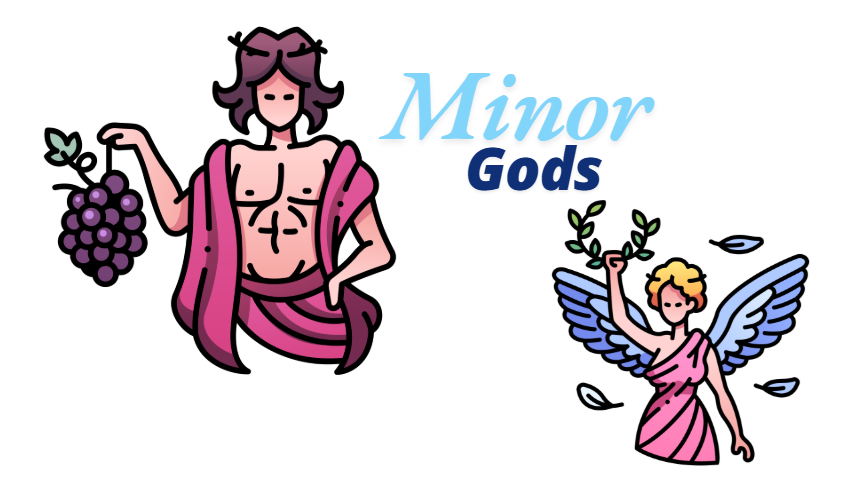
What is a Minor God? In Greek mythology, the twelve Olympians — gods like Zeus, Athena, and Poseidon — were the most powerful and ruled over the biggest parts of the world. But beneath them were hundreds of other gods and goddesses known as the minor gods. They were not called "minor" because they were weak or unimportant — they were called minor because they did not hold one of the twelve thrones on Mount Olympus. Minor gods controlled the everyday forces of nature and life that the Olympians were too busy to manage: things like sleep, dreams, the winds, the rivers, rainbows, luck, revenge, and love. Without the minor gods, the world the Greeks imagined would have fallen apart. They were the ones who kept everything running while the Olympians fought, feasted, and argued on Mount Olympus.
Helios — God of the Sun: Helios drove the sun across the sky every day in a magnificent golden chariot pulled by four fiery horses. Because he flew above everything, he saw all things that happened on earth. His most famous story is about his son Phaethon, who begged to drive the sun chariot, lost control, and nearly burned the world before Zeus struck him down with a thunderbolt.
Selene — Goddess of the Moon: Selene was the goddess of the moon and the sister of Helios. Every night, she drove her silver chariot across the sky, pulled by two white horses. She fell in love with a mortal shepherd named Endymion and asked Zeus to grant him eternal sleep so he would never age or die, visiting him every night on her journey across the sky.
Eos — Goddess of the Dawn: Eos was the goddess of the dawn who rose each morning to open the gates of heaven for her brother Helios. Homer called her "rosy-fingered Dawn" in the Iliad and the Odyssey. She asked Zeus to make her mortal lover Tithonus immortal but forgot to ask for eternal youth, so he aged forever until she turned him into a cicada.
Nike — Goddess of Victory: Nike was the winged goddess of victory who flew over every battlefield and competition, and wherever she landed, that side would win. She was one of the first to join Zeus in the war against the Titans, and he kept her by his side forever after. The famous Winged Victory of Samothrace statue still stands in the Louvre today — and the shoe company Nike is named after her.
Eros — God of Love: Eros was the mischievous god of love who carried a bow with golden arrows that made people fall in love and lead arrows that made them reject love. He once scratched himself with his own arrow and fell in love with a mortal woman named Psyche, and their love story became one of the greatest tales in Greek mythology. The Romans later called him Cupid, and he is still the symbol of Valentine's Day.
Iris — Goddess of the Rainbow: Iris was the goddess of the rainbow and the personal messenger of Hera, queen of the gods. She traveled between the worlds of gods and mortals by riding on a rainbow, delivering commands and messages. While Hermes was the messenger of Zeus, Iris served Hera faithfully and could travel anywhere — the sky, the earth, the ocean floor, and even the Underworld.
Hypnos — God of Sleep: Hypnos was the god of sleep who could put anyone to rest — mortal, hero, or even a god. He lived in a dark, quiet cave where the river of forgetfulness flowed and poppies grew all around. Even Zeus was afraid of him, because not even the king of the gods could resist sleep forever.
Thanatos — God of Death: Thanatos was the god of peaceful death and the twin brother of Hypnos. He was not evil or cruel — he simply came when it was a person's time and carried their soul gently to the Underworld. The clever king Sisyphus once managed to trick and chain him up, and while Thanatos was chained, no one on earth could die until Ares freed him.
Morpheus — God of Dreams: Morpheus was the god of dreams and the son of Hypnos. While his father put people to sleep, Morpheus shaped the dreams they experienced, taking the form of any person so realistically that dreamers could not tell the difference from real life. The word "morphine" comes from his name, because the drug brings a dreamlike state.
Nyx — Goddess of the Night: Nyx was the goddess of the night, born from Chaos itself at the very beginning of the universe. Even Zeus feared her and did not dare challenge her. She was the mother of many powerful children, including Hypnos, Thanatos, Nemesis, and Eris, and despite being one of the most powerful forces in existence, she rarely appeared in myths — which made her even more terrifying.
Hecate — Goddess of Magic and Crossroads: Hecate was a dark and mysterious goddess of magic, witchcraft, ghosts, and crossroads who wandered the earth at night carrying flaming torches with a pack of ghostly dogs at her side. She was one of the few Titans who kept her power after the Olympians won the war, because she sided with Zeus. Travelers left food offerings called "Hecate's suppers" at crossroads where three roads met, hoping to earn her protection.
Eris — Goddess of Discord: Eris was the goddess of chaos, strife, and arguments who loved nothing more than stirring up trouble. Her most famous act started the entire Trojan War — when she was not invited to a wedding, she tossed a golden apple labeled "For the Fairest" into the crowd. Hera, Athena, and Aphrodite all claimed it, and their argument eventually led to the ten-year Trojan War.
The Graces (Charites) — Goddesses of Beauty and Joy: The three Graces — Aglaea (Splendor), Euphrosyne (Joy), and Thalia (Festivity) — were goddesses of beauty, charm, and joy. They were daughters of Zeus and were often found dancing together in a circle, representing how beauty, joy, and celebration are all connected. No feast on Mount Olympus was complete without them.
Boreas, Zephyrus, Notus, and Eurus — The Four Wind Gods: Each of the four directions had its own wind god. Boreas brought cold winter storms from the north, Zephyrus brought warm spring breezes from the west, Notus brought the heat and storms of late summer from the south, and Eurus brought warmth and rain from the east. The Greeks paid close attention to which wind was blowing because it could mean the difference between smooth sailing and a shipwreck.
Nemesis — Goddess of Revenge: Nemesis was the goddess of revenge and divine punishment. If a person grew too proud, boasted too loudly, or received more fortune than they deserved, Nemesis would come to bring them back down and restore balance. The Greeks deeply believed that the universe needed balance, and Nemesis was the terrifying force that kept it.
Tyche — Goddess of Fortune: Tyche was the goddess of luck, fortune, and chance. She was often shown holding a cornucopia in one hand and a ship's rudder in the other, symbolizing that she steered the fate of people and entire cities. The Greeks believed she could change someone's fortune in a single moment — lifting a beggar to become a king, or toppling a king into ruin.
Hebe — Goddess of Youth: Hebe was the goddess of youth and the daughter of Zeus and Hera. Her job on Mount Olympus was to serve nectar and ambrosia to the gods — the divine food and drink that kept them immortal. She later married the hero Heracles after he died and became a god, restoring his youth and giving him eternal life on Olympus.
Phobos and Deimos — Gods of Fear and Terror: Phobos and Deimos were the sons of Ares and Aphrodite. Phobos was the god of fear and panic, and Deimos was the god of terror and dread — together they rode into every war alongside their father, spreading fear through the enemy ranks. The two moons of the planet Mars are named after them.