Parents: Zeus and Alcmene
Childhood: Hercules had a twin brother named Iphicles, but unlike Hercules, Iphicles was fully mortal — his father was Amphitryon, Alcmene's human husband, while Hercules was the son of Zeus. Even as an infant, Hercules showed incredible strength. Hera, furious that he was the son of Zeus and a mortal woman, sent two venomous serpents to kill both twins in their crib. While Iphicles screamed in terror, baby Hercules grabbed the snakes and strangled them with his bare hands.
Story: Hercules was the greatest hero in Greek mythology, famous for his unmatched strength and courage. Driven temporarily mad by Hera, he committed a terrible act and was ordered by King Eurystheus to complete twelve seemingly impossible labors as punishment. After completing all twelve, he went on to have many more adventures. After his death, Zeus raised him to Mount Olympus, where he finally became a full god and reconciled with Hera.
The Twelve Labors:
1. The Nemean Lion: Hercules was sent to slay a monstrous lion whose golden fur could not be pierced by any weapon. After his arrows and sword proved useless, Hercules trapped the lion in its cave and strangled it with his bare hands. He skinned it using its own claws and wore the lion's hide as armor for the rest of his life.
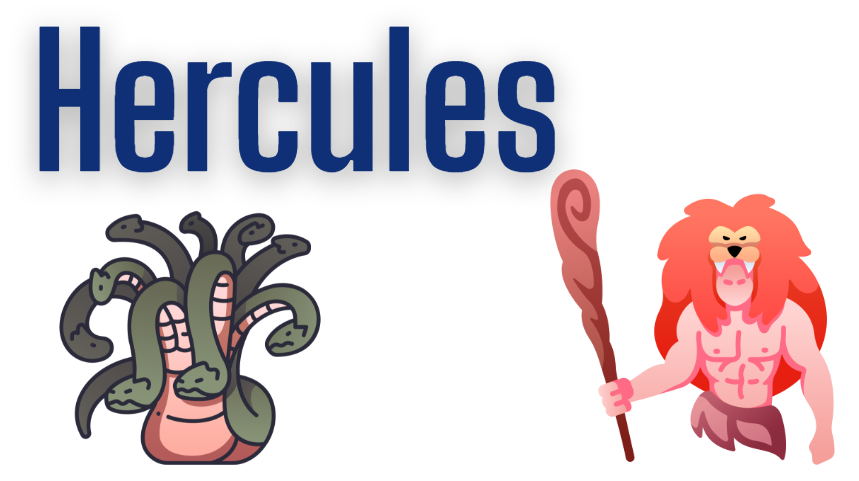
2. The Lernaean Hydra: Hercules faced a serpent with nine heads that lived in the swamps of Lerna. Every time he cut off one head, two more grew back in its place. With the help of his nephew Iolaus, who burned each neck stump to stop the heads from regrowing, Hercules finally destroyed the Hydra. He dipped his arrows in its poisonous blood, making them deadly forever after.
3. The Ceryneian Hind: Hercules was tasked with capturing a sacred golden-horned deer that belonged to the goddess Artemis. He chased the incredibly fast deer for an entire year before finally catching it. He carefully brought it back alive, explaining to Artemis that he meant no disrespect, and she allowed him to complete the labor.
4. The Erymanthian Boar: Hercules had to capture a giant, ferocious boar alive from Mount Erymanthos. He chased the boar through deep snow until it was exhausted, then trapped it in a snowdrift and bound it in chains. He carried the massive beast back to Eurystheus, who was so terrified he hid inside a bronze jar.
5. The Augean Stables: King Augeas owned thousands of cattle, and his stables had not been cleaned in thirty years. Hercules was ordered to clean them in a single day — a task meant to be humiliating and impossible. Instead of shoveling, Hercules diverted two rivers to flow through the stables, washing them completely clean in hours. Eurystheus refused to count this labor because Hercules had demanded payment from Augeas.
6. The Stymphalian Birds: A flock of man-eating birds with bronze beaks, sharp metal feathers, and poisonous droppings terrorized the people near Lake Stymphalia. Athena gave Hercules a pair of bronze rattles forged by Hephaestus. The noise startled the birds into the air, and Hercules shot them down one by one with his Hydra-poisoned arrows.
7. The Cretan Bull: Hercules traveled to the island of Crete to capture a massive, fire-breathing bull that was ravaging the land. He wrestled the bull into submission with his bare hands and brought it back to Eurystheus alive, carrying it across the sea on his back.
8. The Mares of Diomedes: King Diomedes of Thrace owned four wild mares that he fed on human flesh, making them mad and vicious. Hercules overpowered Diomedes and fed the cruel king to his own horses. Once the mares had eaten, they became calm enough for Hercules to bind their mouths and bring them back.
9. The Belt of Hippolyta: Eurystheus's daughter wanted the magical war belt of Hippolyta, queen of the Amazons. Hippolyta was impressed by Hercules and was willing to give him the belt peacefully. However, Hera disguised herself and spread a rumor among the Amazons that Hercules was kidnapping their queen, sparking a battle in which Hercules was forced to fight and take the belt by force.
10. The Cattle of Geryon: Hercules had to travel to the far western edge of the world to steal the cattle of Geryon, a fearsome giant with three bodies. Along the way, Hercules split a mountain in two, creating the Pillars of Hercules (the Strait of Gibraltar). He killed Geryon and his two-headed guard dog, then drove the cattle all the way back to Greece.
11. The Apples of the Hesperides: Hercules was sent to steal golden apples from a garden guarded by a hundred-headed dragon and the nymphs known as the Hesperides. He tricked the Titan Atlas — who held up the sky — into fetching the apples by offering to hold the sky for him. When Atlas returned and tried to leave Hercules holding the sky forever, Hercules outsmarted him by asking Atlas to hold it "just for a moment" while he adjusted his cloak, then took the apples and left.
12. Cerberus: The final and most dangerous labor sent Hercules into the Underworld itself to capture Cerberus, the three-headed dog that guarded the gates of the dead. Hades agreed to let Hercules take Cerberus — but only if he could overpower the beast using no weapons. Hercules wrestled the massive three-headed dog into submission with nothing but his strength, dragged it to the surface to show Eurystheus, and then returned Cerberus safely to the Underworld.
Symbol: Lion skin, club, bow and arrow.
Represents: Strength, courage, heroism, and endurance.