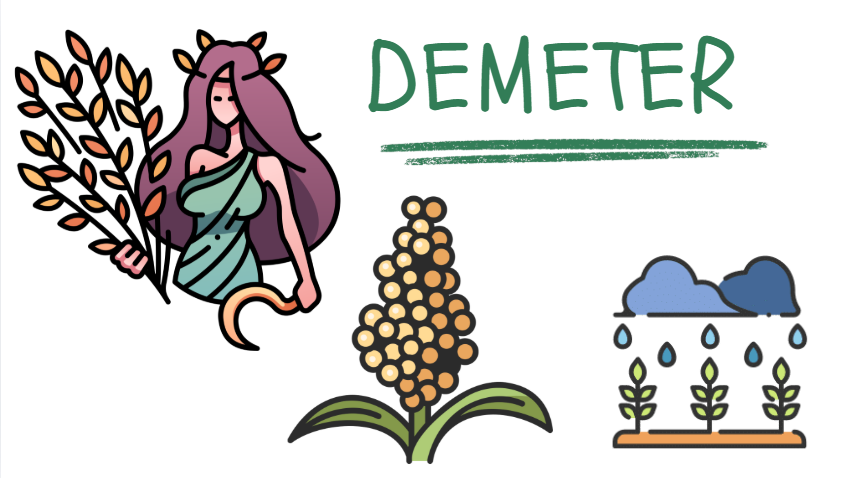
Parents: Cronus and Rhea
Birth: Demeter was swallowed by her father Cronus at birth. She was later freed by her youngest brother Zeus, who forced Cronus to release all the children he had swallowed.
Story: Demeter was the goddess of the harvest, grain, and fertility. When her daughter Persephone was taken to the Underworld by Hades, Demeter's grief was so great that she refused to let anything grow. The world fell into an endless winter and humanity began to starve. Zeus was forced to intervene, but because Persephone had eaten pomegranate seeds in the Underworld, she had to return to Hades for part of each year. This is why the Greeks believed the seasons change — when Persephone is with Hades, Demeter mourns and winter comes, and when she returns, spring and summer follow.
The Search for Persephone: When Persephone vanished, Demeter searched the entire world for nine days and nine nights, carrying flaming torches and refusing to eat or drink. She disguised herself as an old woman and wandered among mortals, consumed by grief. Finally, Helios, the god of the sun who sees everything, told her the truth — Hades had taken Persephone, and Zeus had allowed it. In her rage and sorrow, Demeter withdrew her blessing from the earth, and all crops died. Famine spread across the world, and humanity faced extinction until Zeus was forced to intervene.
The Eleusinian Mysteries: During her search, Demeter rested in the city of Eleusis and was kindly treated by the people there. In gratitude, she taught them sacred religious rites that became known as the Eleusinian Mysteries — the most important and secretive religious ceremonies in ancient Greece. Participants believed that the Mysteries revealed the secrets of life after death, and those who were initiated were promised a blessed afterlife. The ceremonies were held for nearly two thousand years, and revealing their secrets was punishable by death.
Symbol: Sheaf of wheat, torch, cornucopia.
Represents: The harvest, agriculture, fertility, and the seasons.